If you’ve got a flat or low-slope roof and it’s time to replace it, you’ve probably run into the same two names over and over: EPDM and TPO. They’re the two most common flat roofing membranes in the country, they look pretty similar once they’re down. Neither one is “better,” They’re just good at different things. The right call depends on your building, your budget, your climate, and, more than anything, who puts it on.
The Quick Answer (EPDM vs TPO at a Glance)
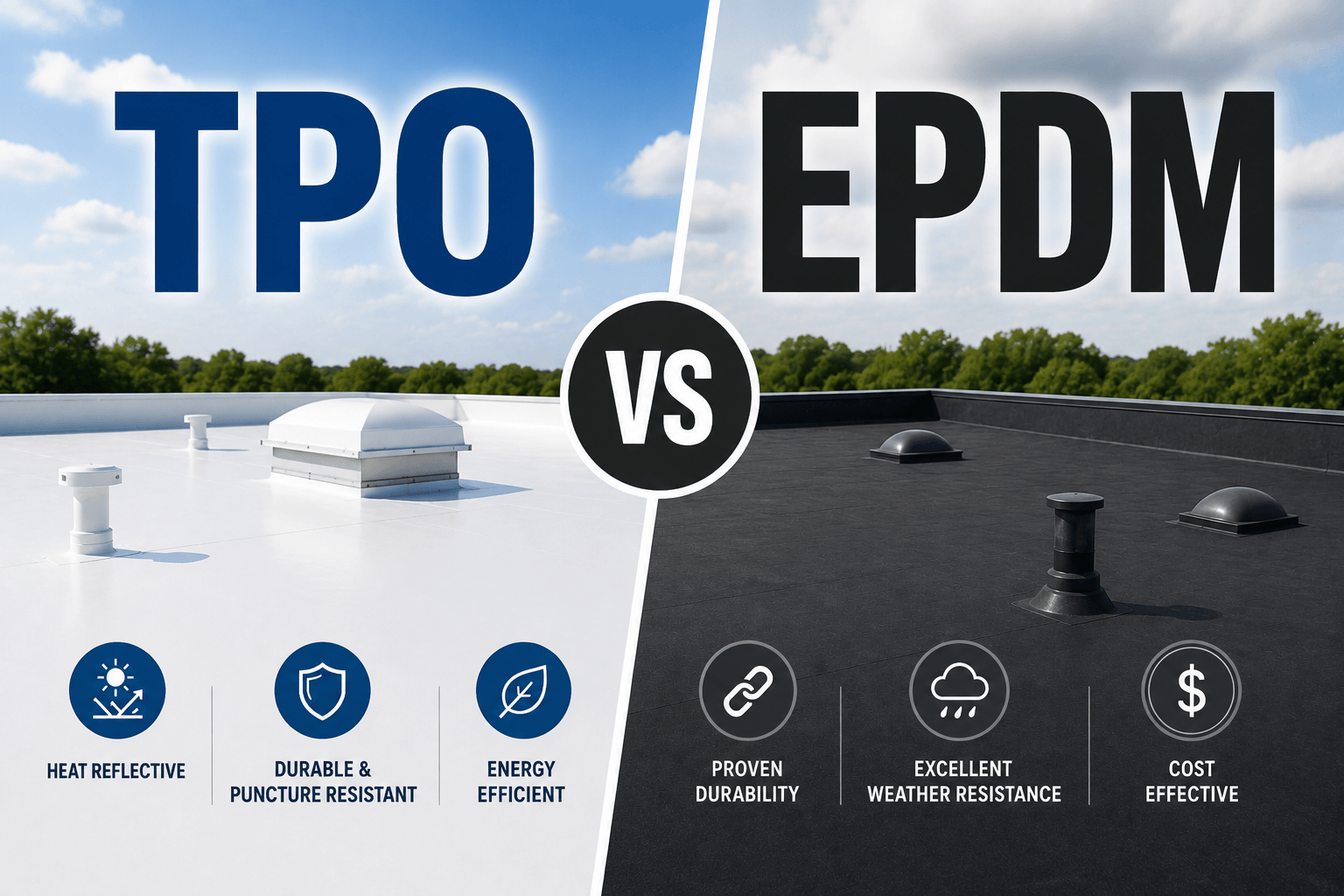
If you only read one paragraph, read this one. EPDM is a black synthetic rubber membrane that’s been proven on roofs since the 1960s. It’s flexible, tough, long-lasting, and excellent in cold weather. TPO is a (usually white) thermoplastic membrane with heat-welded seams that reflects the sun and keeps buildings cooler. EPDM tends to win on cold-weather durability and a longer track record, while TPO tends to win on energy efficiency and seam strength. For most St. Louis buildings, it comes down to one question: are you optimizing for summer cooling (lean TPO) or maximum cold-weather resilience and the longest proven lifespan (lean EPDM)?
Now let’s get into the details.
Understanding the Main Differences Between EPDM and TPO Roofing
Before you can compare them, it helps to know what each membrane actually is and where each one tends to perform best.
What Is EPDM Roofing?
EPDM stands for ethylene propylene diene monomer, which is a mouthful that basically just means synthetic rubber. You’ll hear people call it a “rubber roof,” and that’s exactly right. It’s been protecting flat roofs since the 1960s, which makes it the longest-proven single-ply membrane on the market. Six decades of real-world roofs is a lot of receipts.
What Defines EPDM
- It usually comes in black (white is available, but it costs more).
- It’s installed one of three ways: fully adhered (glued down), mechanically attached (fastened), or ballasted (held in place with stone or gravel).
- Its seams are joined with specialized seam tape or adhesive, because EPDM is a thermoset rubber and can’t be melted and welded back together.
Where EPDM Performs Best
EPDM is at its best in cold climates and freeze-thaw country, where its black surface soaks up heat and helps shed snow and ice. It’s also a great fit for buildings that want a proven, low-drama system, and for roofs where flexibility matters. EPDM stays pliable and stretches with the building instead of cracking, which is a real advantage when temperatures swing from single digits to ninety-plus, like they do here.
What Is TPO Roofing?
TPO stands for thermoplastic polyolefin. Unlike EPDM, it’s a thermoplastic, and that one word is the key to its biggest strength. Because it’s thermoplastic, its seams are fused together with hot air, creating a bond that’s essentially one continuous piece of roof. TPO hit the market in the 1990s and has since become the fastest-growing flat roofing material in the country. It’s also our single most-requested flat roof system here in St. Louis.
What Defines TPO
- It usually comes in white (gray and tan are options too), with a reflective surface.
- It’s reinforced with an internal scrim that gives it strong puncture and tear resistance.
- It installs mechanically attached, fully adhered, or ballasted, with heat-welded seams.
A helpful way to think about TPO is that it was engineered to combine the best of both worlds: the weatherability of rubber with the strong, heat-welded seams of PVC.
Where TPO Performs Best
TPO is at its best on hot, sunny exposures and energy-conscious buildings, where that reflective surface can take a real bite out of summer cooling bills. It’s a natural fit for restaurants, offices, and warehouses, and for any building where you want strong seams without the long-term upkeep that taped seams can eventually need.
What About PVC and Modified Bitumen?
Quick aside, because people always ask: EPDM and TPO aren’t your only options for a flat roof.
PVC is a third single-ply membrane. It’s pricier, but it’s the gold standard when grease or chemicals are in the picture (think restaurant kitchen exhaust), because oils slowly break down both EPDM and TPO. Modified bitumen is another route when you want multiple reinforced layers for heavy foot traffic. We install all of these, so if your building has a special situation, there’s a right answer for it.
For most buildings, though, the real decision lands on EPDM vs TPO. So let’s see how they actually stack up.
Comparing TPO and EPDM, Side by Side
Here’s the quick-reference version. Below the table, we’ll dig into the categories that actually move the decision.
| EPDM | TPO | |
| What it is | Synthetic rubber (thermoset) | Thermoplastic polyolefin |
| On the market since | 1960s | 1990s |
| Usual color | Black (white available) | White (gray/tan available) |
| Seams | Tape or adhesive | Heat-welded (fused) |
| Energy efficiency | Absorbs heat, helps in winter | Reflects heat, cuts summer cooling |
| Puncture & tear | Flexes around impacts; very tough in thicker mils | Scrim-reinforced; strong puncture/tear resistance |
| Cold-weather performance | Excellent, stays flexible | Very good |
| Grease/chemical resistance | Limited | Limited (PVC is better here) |
| Typical lifespan | 25-30+ years | 20-30 years |
| Installed cost (2026) | ~$6-$12 / sq ft | ~$6-$12 / sq ft |
| Best for | Cold-weather durability, proven track record, flexible roofs | Energy savings, strong seams, hot/sunny roofs |
A Category-by-Category Breakdown
Cost
This is where you’ll find the most conflicting information online, so here’s the straight story.
The EPDM membrane itself is usually a little cheaper by the roll. But, and this is the part most articles skip, the installed cost often evens out, and can even tip toward TPO. Why? EPDM seams are taped or glued, which takes more labor hours, while TPO’s heat-welded seams go down faster, especially on big open roofs. So the material savings get partly eaten up by labor.
In 2026, both systems typically land around $6-$12 per square foot installed, depending on roof size, membrane thickness (45, 60, or 80 mil), insulation, whether the old roof needs to be torn off, and how many penetrations (HVAC units, drains, vents) your roof has. PVC generally runs higher.
The takeaway: don’t choose based on the membrane price tag alone. The total installed number is what matters, and the two are close enough that performance and fit should drive the decision, not a few cents per square foot. (And every roof is different, so the only number that really counts is the one on your actual estimate.)
Energy Efficiency
This is TPO’s headline feature. That white, reflective surface bounces UV and heat away instead of soaking it up, which can noticeably lower cooling costs through a St. Louis summer, and our summers are no joke.
EPDM does the opposite: its black surface absorbs heat. That sounds like a knock, but in winter it’s actually useful. It helps melt snow and ice and can trim heating costs, especially on north-facing sections. (White EPDM exists if you want a reflective rubber roof, though it costs more.)
In our mixed climate, with humid, hot summers and genuinely cold winters, this is often the tiebreaker. Optimize for cooling, and TPO makes sense. Lean into cold-weather performance, and EPDM has the edge.
Durability, Weather, and Hail
Both are tough, proven membranes, but they’re tough in different ways.
TPO is reinforced with an internal scrim that gives it excellent puncture and tear resistance, which is great for roofs that see foot traffic or service crews. EPDM’s superpower is elasticity: it stretches and flexes with the building and with temperature swings, so it tends to ride out minor impacts and our brutal freeze-thaw cycles without cracking. In thicker membranes, EPDM is remarkably puncture-resistant, too.
And when hail rolls through (which, around here, it will), EPDM’s flexibility often helps it shrug off impacts a little better, while TPO’s reinforced strength holds up well against punctures and tears. There’s no loser in this category. Just two different kinds of tough.
Seams and Installation (The Real Difference)
If you remember one technical thing from this whole guide, make it this: the biggest functional difference between TPO and EPDM is how the seams are joined, and it comes straight from their chemistry.
TPO is a thermoplastic, so its seams are heat-welded, melted together into one continuous surface. EPDM is a thermoset rubber, so it can’t be melted; its seams are bonded with tape or adhesive.
Why does that matter so much? Because seams are where flat roofs leak. Heat-welded TPO seams are extremely strong and don’t depend on an adhesive that can degrade over time. Taped and glued EPDM seams are proven and reliable when they’re installed correctly, but the adhesive can break down over the years, which is why older EPDM roofs sometimes need a little seam maintenance down the road. (TPO welds can also be done in cold weather, which stretches out the installable season.)
Either way, seam quality lives and dies by the installer. A perfect membrane with a sloppy seam is just a future leak with a delay timer on it.
Lifespan
You’ll see all kinds of numbers thrown around, so here are the honest ranges. A well-installed, well-maintained EPDM roof commonly lasts 25-30+ years, and thanks to its six-decade track record, we genuinely know it goes the distance. TPO typically lasts 20-30 years. It’s a newer material, and earlier formulations had a shorter track record, but today’s TPO is significantly improved over the early stuff.
The variables that actually move the number: membrane thickness, attachment method, sun exposure, drainage (standing water is the enemy of any flat roof), and, say it with us, maintenance. Both materials can hit the top of their range with regular upkeep, or fall well short of it without.
Maintenance and Repairs
Both are low-maintenance by roofing standards, but they age and repair a little differently.
EPDM is famously repairable. People call it “infinitely repairable” for a reason, and plenty of EPDM roofs run well past their rated life because seams and small spots are easy to patch. TPO is also easy to repair (you simply re-weld it), and because welds leave no adhesive seam, leaks are less likely to start in the first place.
For either one, an annual inspection and keeping the drains clear does more for your roof’s lifespan than the material choice ever will.
Warranties (Don’t Skip This)
Here’s something the spec sheets won’t tell you: the warranty matters as much as the membrane.
Both EPDM and TPO come with manufacturer warranties, typically in the 20-30 year range, and you’ll generally see two kinds. A material-only warranty covers the membrane itself. An NDL (No Dollar Limit) warranty covers both materials and labor on covered repairs. That’s the stronger protection, and it’s what you want on a commercial building.
The catch: those warranties are only valid when the system is installed by a qualified contractor, to the manufacturer’s spec. That’s a big reason the “who installs it” question isn’t just a sales line. It’s literally what keeps your warranty intact.
Which Membrane Is Right for Your Building?
The honest answer depends on what kind of building you’ve got and what you need the roof to do. Here’s how the decision tends to break down.
Roof Size and Installation Speed
On large, open commercial roofs, TPO’s fast heat-welded installation can save real labor cost and minimize downtime for your tenants or operations.
Energy Codes and Cooling
If you’re the one watching the utility bills across warehouses, retail, or offices, TPO’s reflective surface and Energy Star ratings can pay off every summer, and may help with energy-code compliance or LEED goals.
Foot Traffic and Rooftop Equipment
Roofs loaded with HVAC units and regular service traffic benefit from TPO’s reinforced, puncture-resistant build, though thicker EPDM handles this well, too.
Grease and Chemical Exposure
Restaurant or kitchen exhaust on the roof? Neither EPDM nor TPO loves grease, so that’s a conversation to have with us about PVC.
Budget and Track Record
If you want the longest-proven system and maximum cold-weather durability for a St. Louis winter, EPDM still earns its keep.
For most commercial flat roofs in the St. Louis area, TPO has become the go-to. That combination of a reflective surface and strong welded seams is hard to beat for the money. But “most” isn’t “all,” and we’ve installed plenty of EPDM where it was simply the smarter call for the building.
EPDM vs TPO for Homes and Smaller Flat Roofs
Homeowners with a flat section, whether that’s a garage, a porch, an addition, or a fully flat roof, are choosing between the same two membranes.
EPDM has long been a favorite for residential flat roofs: affordable, forgiving, and tough, especially on smaller or shaded sections. TPO is a great residential pick when energy efficiency is the priority, or when you want those welded seams over living space you’re trying to keep cool. For a small detached garage, EPDM usually does the job beautifully. For a sunny addition, TPO might edge it out.
Which Should You Choose?
Lean Toward EPDM If
You want a proven, long-lasting, low-drama membrane; cold-weather and freeze-thaw resilience matter most; you’ve got a smaller, shaded, or movement-prone roof; or you value easy long-term repairability.
Lean Toward TPO If
Cutting summer cooling costs is a priority; you want the strongest possible seams; you’ve got a large commercial roof; or you simply want a bright, clean, reflective surface up there.
The Bottom Line
Honestly? For a lot of buildings, you could go either way and be happy.
EPDM is the proven, flexible, cold-weather workhorse. TPO is the reflective, strong-seamed energy saver. Both are excellent. The right one depends on your building, your budget, and your goals, and the best way to find out is to have someone who installs both come take a look at your actual roof.
That’s us. Hulsey Roofing has been doing flat roofs right for 40+ years. We’re licensed, bonded, insured, BBB-accredited, and straight with you about your options. No upselling, no pressure. Whether the answer is EPDM, TPO, or something else entirely, we’ll tell you what actually fits.
Take a look at ourflat roofing services, or get a free, no-obligation estimate, and let’s make sure your next flat roof is the last one you have to think about for a long, long time.
EPDM vs TPO Roofing FAQs
Is TPO or EPDM better?
Neither is universally better. TPO wins on energy efficiency and seam strength, while EPDM wins on cold-weather flexibility and a longer proven track record. The best choice depends on your climate, building type, and budget, and on the quality of the installation.
Which lasts longer, EPDM or TPO?
EPDM commonly lasts 25-30+ years and has six decades of proven performance behind it. TPO typically lasts 20-30 years. In practice, membrane thickness, drainage, and regular maintenance decide whether either one reaches the top of its range.
Is EPDM or TPO cheaper?
The EPDM membrane is usually cheaper by the roll, but installed costs are close. Both land around $6-$12 per square foot in 2026, because TPO’s heat-welded seams install faster than EPDM’s taped or glued seams. Compare the total installed price, not just the material.
Can you install TPO over an existing EPDM roof?
Often, yes, as long as the existing EPDM is sound, dry, and there aren’t already two roof layers (building code generally caps a roof at two). A cover board usually goes in between. We’ll always assess the existing roof first before recommending a recover versus a full tear-off.
Which is better for cold climates like St. Louis winters?
EPDM has a slight edge in cold, freeze-thaw conditions because it stays flexible and its dark surface helps shed snow and ice. That said, TPO performs well in the cold too, and it can even be heat-welded in cold weather, which keeps the installation season open longer.
Is a “rubber roof” the same as EPDM?
Yes. When someone says “rubber roof,” they’re almost always talking about EPDM.
Do EPDM and TPO need a lot of maintenance?
Both are low-maintenance compared to most roofing. The two things that matter most for either system are an annual inspection and keeping the drains and scuppers clear so water never sits on the membrane.