Here's a fact that surprises most homeowners: when a roof leaks, the shingles usually aren't the problem. The most common source of roof leaks, by a wide margin, is failed or improperly installed flashing.
So what is roof flashing, exactly? Flashing is thin, bendable metal (usually aluminum, galvanized steel, or copper) installed anywhere your roof meets something else: a chimney, a wall, a skylight, a vent pipe, or another section of roof. Shingles do a great job protecting the flat, open stretches of your roof. But every place where the roof is interrupted creates a spot where water wants to sneak in. Flashing is what seals those spots.
Think of it this way: if shingles are your roof's armor, flashing is what protects the joints in that armor. And just like armor, the joints are exactly where attacks succeed.
In this guide, we'll cover what flashing does, every major type and where it goes, the materials it's made from, the warning signs that yours is failing, and what repair typically involves. By the end, you'll know more about flashing than most homeowners ever learn. Most people only learn the hard way, with a water stain on the ceiling.
What Does Roof Flashing Do?
Flashing has one job: redirect water away from the places it could enter your home.
Water is relentless and surprisingly clever. It flows downhill, yes, but it also gets driven sideways by wind, wicks into tiny gaps through capillary action, and pools anywhere it's allowed to sit. Every transition point on your roof creates an opportunity: the gap where a chimney rises through the shingles, the seam where a roof plane meets a wall, the opening cut for a vent pipe.
Flashing works by creating a waterproof path over and around these vulnerable points. Properly installed flashing is layered into the roofing materials, woven under shingles on the uphill side and over them on the downhill side, so that water flowing down the roof passes over each transition without ever finding an entry point. Gravity does the work. The flashing just makes sure there's nowhere for the water to go but down and off the roof.
When flashing is missing, corroded, or installed wrong, those transition points leak. And because the water often travels along rafters or inside walls before it shows up, flashing leaks are notorious for appearing far from their actual source. That stain on your bedroom ceiling might trace back to a chimney fifteen feet away.
Flashing is one piece of your roof's larger drainage system, which works together with the underlayment, gutters, and drip edges to move water off and away from your home. If you want to see how all these components fit together, check out our complete guide to the different parts of a roof.
The Types of Roof Flashing (and Where Each One Goes)
"Flashing" is really a family of components, each shaped for a specific location on your roof. Here are the types you'll find on a typical home.
Step Flashing
Step flashing is used where a sloped roof meets a vertical wall, like the side of a dormer or where a lower roof runs into a second-story wall. It consists of individual L-shaped pieces of metal, each one layered between courses of shingles in an overlapping "staircase" pattern. Water that hits the wall runs down onto the flashing, then onto the shingle below, then onto the next piece of flashing, step by step down the roof.
Worth knowing: Step flashing must be installed piece by piece as the shingles go on. It can't be properly retrofitted by smearing caulk along the wall joint, a shortcut that fails within a few seasons.
Counter Flashing (Cap Flashing)
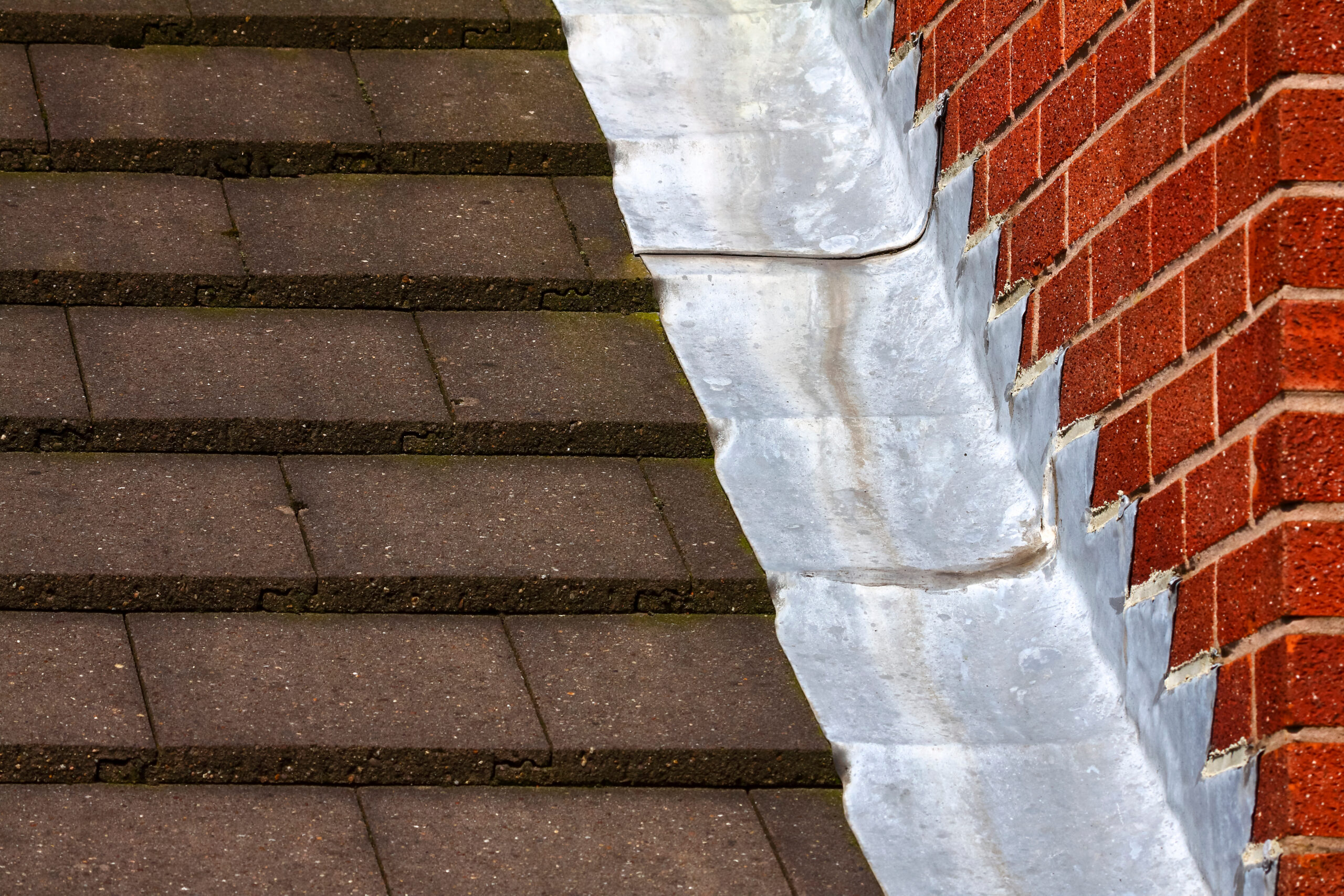
Counter flashing works as the second layer in a two-part system, most commonly around chimneys. While step or base flashing directs water off the roof surface, counter flashing is embedded into the chimney's masonry (in a cut groove called a reglet) and folds down over the base flashing below it. The two layers overlap like shingles themselves, so water running down the chimney face never reaches the seam.
Chimney Flashing
Chimney flashing isn't a single piece. It's a complete system that combines several types: base flashing across the front (downhill side), step flashing up both sides, counter flashing embedded in the masonry, and a cricket or saddle flashing behind it.
Why it matters: Chimneys are the single most leak-prone feature on most roofs. They're large, they interrupt the water flow completely, and masonry and roofing materials expand and contract at different rates. A proper chimney flashing job is genuinely skilled work.
Valley Flashing
A roof valley, the V-shaped channel where two roof planes meet, handles enormous volumes of water since it collects runoff from both slopes at once. In an open valley installation, a wide W-shaped or V-shaped metal channel runs the length of the valley, giving all that water a durable, waterproof highway to the gutters. (Some roofs use "closed" valleys where shingles cross over the valley instead; open metal valleys generally last longer and shed debris better.)
Vent Pipe Flashing (Pipe Boots)
Every plumbing vent pipe that pokes through your roof needs its own flashing, usually a one-piece unit called a pipe boot, with a metal or plastic base plate and a rubber (neoprene) collar that seals around the pipe.
Worth knowing: The rubber collar on a standard pipe boot often cracks from UV exposure in 10 to 15 years, well before the shingles around it wear out. Failed pipe boots are one of the most common and most overlooked sources of roof leaks.
Drip Edge
Drip edge is the narrow metal strip installed along all the edges of your roof, both at the eaves on the bottom and the rakes along the sides. It directs water off the roof edge and into the gutters instead of letting it curl back under the shingles or run down your fascia boards. It's a small, inexpensive component that most building codes now require, and for good reason.
Skylight Flashing
Skylights combine a roof penetration with glass and a frame, which makes proper flashing essential. Most skylight manufacturers sell flashing kits engineered for their specific units, typically a combination of head flashing above, step flashing along the sides, and sill flashing below. When a skylight "leaks," the flashing (or its installation) is usually the culprit, not the skylight itself.
Kickout Flashing (Diverter Flashing)
Kickout flashing is a small, angled piece installed at the exact point where a roof edge meets a wall and the roof ends. Its job is to "kick" water away from the wall and into the gutter.
Why it matters: It's tiny, it's frequently omitted by inattentive installers, and its absence causes some of the sneakiest damage in residential construction: water quietly running down inside the wall for years, rotting sheathing and framing before anyone notices.
Quick Reference: Flashing Types at a Glance
| Flashing Type | Where It Goes | What It Protects Against |
|---|---|---|
| Step flashing | Roof-to-wall transitions, dormer sides | Water entering along wall seams |
| Counter flashing | Embedded in masonry, over base flashing | Water running down chimney faces |
| Chimney flashing | Around all four sides of a chimney | The #1 leak point on most roofs |
| Valley flashing | V-channels where roof planes meet | High-volume runoff from two slopes |
| Pipe boots | Around plumbing vent pipes | Leaks at pipe penetrations |
| Drip edge | All roof edges (eaves and rakes) | Water curling under shingle edges |
| Skylight flashing | Around skylight frames | Leaks at the roof opening |
| Kickout flashing | Where a roof edge ends at a wall | Hidden water damage inside walls |
What Is Roof Flashing Made Of?
Flashing materials vary in cost, durability, and appearance. Here's how the common options compare.
| Material | Typical Lifespan | Cost | Best For |
|---|---|---|---|
| Aluminum | 20-30 years | $ | Most residential applications; lightweight and easy to form |
| Galvanized steel | 20-30 years | $ | Durable general-purpose choice; the most common option |
| Copper | 50+ years | $$$ | Premium homes, chimneys, historic properties; develops a patina |
| Lead | 50+ years | $$ | Masonry and chimney work; extremely malleable |
| PVC / rubber | 10-15 years | $ | Pipe boots and specialty applications |
A few practical notes:
- Aluminum shouldn't be in direct contact with masonry or pressure-treated lumber without a protective coating, since the alkaline and chemical content corrodes it over time.
- Galvanized steel is the workhorse: affordable and durable, though it can eventually rust once the zinc coating wears through.
- Copper costs significantly more upfront but can outlast two full roof replacements, which is why it's the traditional choice for chimney flashing on higher-end homes.
- The rubber collars on pipe boots are almost always the first flashing component to fail on a roof. Upgraded silicone or all-metal boots last considerably longer.
6 Warning Signs Your Roof Flashing Is Failing
Flashing problems rarely announce themselves until water is already getting in. Here's what to look for from the ground, from the attic, and on your ceilings.
1. Water Stains on Ceilings or Walls
Brown or yellowish stains on ceilings or upper walls, especially near a chimney, around a skylight, or below a roof-to-wall transition, are the classic sign of a flashing leak. Remember that water travels: the stain marks where water exited, not necessarily where it entered.
2. Visible Rust, Corrosion, or Holes
From the ground with binoculars (or during a professional inspection), corroded, rusted, or pitted flashing is a clear signal it's near the end of its life. Small holes and rust spots only grow.
3. Cracked, Dried, or Lifting Sealant
If you can see beads of caulk or roofing cement along flashing edges that have cracked, shrunk, or peeled away, the seal is compromised. Worth noting: large amounts of caulk smeared around chimneys or walls is often a sign that a previous repair took a shortcut instead of properly re-flashing the area. Those shortcuts fail fast.
4. Bent, Loose, or Missing Flashing Pieces
High winds, falling branches, ice, and even foot traffic during other home repairs can bend flashing or pull it loose. A gap between the flashing and the surface it's supposed to seal is an open door for water.
5. Granule Loss or Damaged Shingles Around Transitions
Deteriorating shingles concentrated around chimneys, walls, or valleys (while the rest of the roof looks fine) often indicates water is moving where it shouldn't be in those areas.
6. Cracked Rubber on Pipe Boots
Look at your vent pipes (again, binoculars help). If the rubber collar around the pipe is visibly cracked, split, or deteriorated, water is likely already following the pipe down into your attic. This is one of the most common flashing failures, and one of the cheapest to fix if caught early.
Why Flashing Fails
Understanding what kills flashing helps you understand why inspections matter.
Age and Corrosion
Metal flashing oxidizes over decades of sun, rain, and temperature swings. Galvanized coatings wear through, aluminum pits, and sealants dry out. Even perfect flashing has a lifespan.
Thermal Movement
Your roof expands and contracts every single day as temperatures swing, and in regions with hot summers and freezing winters, those swings are extreme. Flashing endures this movement at exactly the joints where two different materials (masonry and asphalt, wood and metal) move at different rates. Over years, that movement fatigues metal, loosens fasteners, and breaks sealant bonds.
Poor Installation
This is the big one. Flashing installed with shortcuts fails years or decades before properly installed flashing would. Common shortcuts include surface-caulking instead of embedding, face-nailing where it shouldn't be, and reusing old flashing during a roof replacement when it should have been replaced. When roofers say most leaks come from flashing, what they often mean is that most leaks come from flashing that was never installed right in the first place.
Storm Damage
Wind can lift and bend flashing, hail can dent and puncture it, and ice dams can force water up and under it. After any major storm, flashing points deserve a look.
Reused Flashing During Reroofs
When a roof is replaced, old flashing is sometimes left in place to save time and money. Sometimes that's acceptable, but flashing that's already 20 years old will not last another 25-year shingle cycle. Ask your roofer specifically what their plan is for flashing during a replacement.
Can You Repair Flashing, or Does It Need Replacement?
It depends on what's failing and how badly.
When Repair Makes Sense
- A single loose or lifted piece that can be re-secured and resealed
- A failed pipe boot, which can be replaced individually in under an hour
- Localized sealant failure where the metal itself is sound
- Minor storm damage to an isolated section
When Replacement Makes Sense
- Widespread rust or corrosion across multiple flashing points
- Chimney flashing that's been "repaired" with layers of roofing cement (tar). At that point, proper step and counter flashing needs to be rebuilt
- Flashing that was improperly installed from the start
- Any reroofing project, since new shingles deserve new flashing in almost every case
A Word of Caution About DIY
While replacing a pipe boot is within reach for a confident homeowner comfortable on a roof, chimney and step flashing genuinely are not. Proper flashing is woven into the shingle courses and, for chimneys, cut into the masonry itself. The tube-of-caulk approach that most DIY repairs amount to is exactly the shortcut that causes long-term damage. It can even trap water behind the flashing and make things worse. Add in the fall risk, and this is a job where a professional pays for itself.
How Much Does Flashing Repair Cost?
Costs vary by location, roof complexity, and accessibility, but these ranges give you a realistic picture of what to expect.
| Repair | Typical Cost Range |
|---|---|
| Pipe boot replacement | $75-$300 |
| Drip edge repair/replacement (per section) | $100-$500 |
| Step flashing repair (roof-to-wall section) | $300-$1,000 |
| Valley flashing replacement | $400-$1,500 |
| Full chimney re-flashing | $500-$1,500+ |
| Skylight re-flashing | $300-$800 |
Two things worth keeping in mind. First, these numbers are small compared to what a flashing leak costs when it goes unaddressed. Rotted decking, damaged insulation, mold remediation, and interior repairs can run into the many thousands. Second, if multiple flashing points are failing at once on an older roof, that's often a sign the whole roof is approaching the end of its life, and it's worth having a professional assess whether repair or replacement is the better investment.
Frequently Asked Questions About Roof Flashing
How long does roof flashing last?
Aluminum and galvanized steel flashing typically last 20 to 30 years, roughly the lifespan of an asphalt shingle roof. Copper can last 50 years or more. The rubber collars on pipe boots are the weak link, often failing in 10 to 15 years.
Is flashing replaced when a roof is replaced?
It should be, in almost every case. Some roofers reuse old flashing to cut costs, but flashing that's already decades old won't survive another full shingle cycle. When getting roof replacement quotes, ask specifically whether all flashing is being replaced. It's a good way to gauge the thoroughness of the contractor.
Why does my chimney keep leaking even after it's been "sealed"?
Because sealing isn't flashing. Caulk and roofing cement are temporary patches that shrink, crack, and fail within a few seasons. A chimney that keeps leaking almost always needs its step and counter flashing properly rebuilt, with the counter flashing cut into the masonry, not another layer of tar.
Can flashing leak without any visible damage?
Yes. Improperly layered flashing can look perfectly fine from the outside while channeling water underneath the roofing materials. That's one reason attic inspections (looking for water staining on the underside of the decking near chimneys, walls, and penetrations) are part of a thorough roof evaluation.
What's the difference between flashing and drip edge?
Drip edge is a type of flashing, the kind installed along the roof's perimeter edges. When people say "flashing" generally, they usually mean the pieces protecting penetrations and transitions (chimneys, walls, valleys, pipes), but drip edge belongs to the same family and serves the same purpose: directing water where you want it to go.
Does homeowners insurance cover flashing repairs?
Generally, insurance covers flashing damage caused by a sudden event such as a storm, fallen tree, or hail. It typically does not cover failure due to age, wear, or poor installation, which insurers classify as maintenance issues. If a storm damaged your flashing, document it promptly and get a professional inspection to support your claim.
The Bottom Line About Roof Flashing
Flashing may be the least glamorous part of your roof, but it's guarding the exact spots where leaks actually start. Shingles protect the open field. Flashing protects the seams, joints, and penetrations. When roofers trace a leak to its source, flashing is the answer more often than everything else combined.
The good news: flashing problems caught early are among the cheapest roof repairs there are. A $200 pipe boot replacement today beats a $5,000 water damage repair next year. The key is simply knowing your flashing exists, knowing where it is, and having it looked at before small failures become big ones.
Hulsey Roofing has been repairing and installing roofs for over 40 years, and proper flashing work is at the heart of what separates a roof that lasts from one that leaks. If you've spotted any of the warning signs in this guide, or you simply don't know what shape your flashing is in, we offer free inspections that cover every flashing point on your roof, along with everything else.
Not sure what shape your flashing is in? We'll take a look for free.
Call (314) 846-7663 for a FREE Assessment